
I enjoy working with small business owners like coaches, educators, and consultants who specialize in transformational services. Businesses who provide 1-on-1 offerings:
Teaching a fiddle student to master the art of bowing.
Coaching a successful entrepreneur to hit $8M in annual revenues.
Consulting with a startup fundraising an angel round.
Coaching a CEO navigating their first exit.
Consulting with a small business owner automating their marketing and sales pipeline.
Teaching a job seeker best practice application and interview etiquette.
If you’re one of these small business owners, then this article is for you. Your offerings focus on nurturing people towards an aspirational goal and supporting them to become the person who can achieve it.
It’s a real-life magic act: your customer enters a door on the left, articulates their goal, and upon exiting the door on their right, they meet their achievement. Your finely crafted offerings guide customers through an important transition. You teach them the skills needed to achieve their goals. When they lack time to upskill, you provide done-for-you services.
The system works! There’s a huge market for transformational offerings - people want to grow. When you offer services to navigate from point A to point B, you can find great success as a business owner. It’s not easy though, so much of the work depends on you, in the trenches, working with your individual clients or customers.
The Scalability Challenge
You might be thinking, well yeah! that’s where the magic happens, doing the intimate one-on-one work. But once you’ve stabilized this work, many of us can’t help but think longer-term. Setting your sights to increase your revenues, maybe hire more support, and ultimately free up your time from the day-to-day to see the bigger picture.
Here’s where things get tricky. Despite the success and demand for your services, transformational businesses face unique challenges in scaling. The very nature of your work - personalized, hands-on guidance - creates obstacles to growth that other businesses may not encounter.
When scaling coaching, teaching, and consulting, entrepreneurs face time constraints. You’re one person, and there’s only so many hours in the day. You could hire more people to reach more clients and conduct more sessions, but if you’re trying to increase revenues or free up time, you’ll still encounter friction. This is because the transformational business is inherently people-centric and hands-on. You can’t really get around this.
The people-centric nature of transformational businesses creates a double-edged sword: while personally and financially rewarding, these businesses often struggle with scalability. Let me illustrate this challenge with a few real-world examples.
Agency Model
I recently read a post by community consultant Becky Pierson Davidson about her transition from consultant to agency. Reflecting on her past agency experience, she highlights some common scalability issues in the consulting world:
Slim profit margins
Insufficient overhead roles
Ongoing challenge of finding new business
Becky’s reflections weren’t about a solopreneur operation, these challenges showed up in what sounds like a larger agency-model consulting business.
Design Agency
A past client, a global design agency, faced similar hurdles. Their primary challenge was maintaining the delicate balance of keeping a large design staff neither over nor underworked. This client was a solopreneur founder with a team.
As the business scaled, my client was able to step-back from the delivery of the design consulting services. The challenge became managing the daily operations of his staff, who were still deep in the 1-on-1 work.
Corporate Consulting
As a consultant at IBM, I witnessed a different facet of this challenge. In the corporate environment, we faced intense pressure from higher-ups to become more efficient with our time and work longer hours. The executives wanted to scale our operations without fully grasping the deeply personal aspects of our offerings.
This is the nature of people-centric business, the work is personal and meaningful; and really tough to scale! When you’re doing high-leverage, custom work for clients, finding a magic structure for efficiency, repeatability, and scale is difficult.
The good news is group and community structures are a great solution here, and they’re fairly accessible once you understand how to approach them.
The Group and Community Solution
Let’s talk group and community. How can you, the transformational business owner think about approaching this new style of offering? How can you navigate this potential solution without compromising the integrity of your people-centric offerings?
What we’re talking about is transitioning from serving clients 1-on-1 to serving multiple clients simultaneously through structured, repeatable offerings. This 'one-to-many' transition means you can :
Create offerings that don't need to be redesigned for each client.
Serve multiple clients simultaneously, increasing your reach and impact.
Develop a new income stream with higher revenue potential.
Reduce the time required per client in the long term.
Before we get into the how, let’s talk about why group work is such a great tool for scaling your transformational business.
The Power of Group Learning
The biggest reason group work is particularly well-suite for scaling your business is humans are innately social. For hundreds of thousands of years, we’ve been honing our communal nature. We’re skilled at sharing and receiving information in groups—peer and social learning is not only effective, people also enjoy learning together.
Plus, and this is a big bonus, compared to 1-on-1 offerings, in group offerings the business owner is not responsible for providing all of the value. Instead, group services are designed to take advantage of our sociality, to prompt conversations and make connections… among group members.
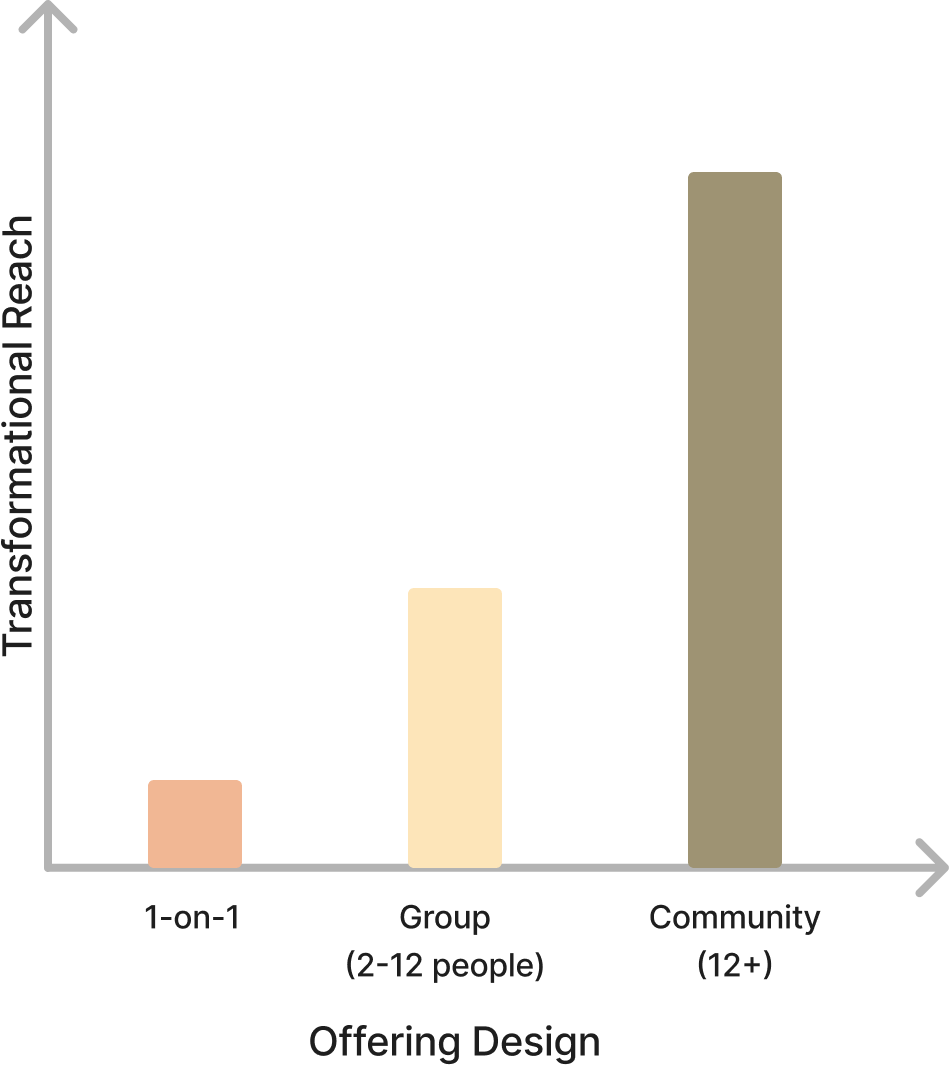
This is a major shift in your offerings, moving into creating structures for group interactions, and opportunities for your customers to learn not only from your expert advice but also directly from their peers. The sharing of perspectives across peers can be massively powerful as a customer on a transformational journey. They not only see how other people are finding success, they also get to share their challenges and receive support.
As the business owner, you can now facilitate group learning instead of providing all of the value yourself in a 1-on-1 container. The results are a transformational reach much greater than what you could provide on your own. You can reach more people, in less time, without losing the value prop.
Alright, now that we understand the benefits of group learning, let’s explore how to transition your business from individual to group offerings.
Making the Move: From 1-on-1 to Many
So, we’re talking about transitioning from offering 1-on-1 services to adding small group (5-12 people) or community offerings (12+) to the mix. It’s worth noting: it doesn’t always work step-wise. Sometimes you can jump from 1-on-1 directly to communal right away.
The short answer for how to make this move is: it really depends on your business and what kind of transformation you’re supporting folks through. You’re looking to design a group or communal offering that matches the outcomes your customers are seeking to achieve. As always, the important work lies in the nuances.
Here are some detailed prompts to get you started on this journey:
Who is your target audience?
Within your current pool of customers, who is likely to be interested in a group offering?
What data can you analyze from social media, emails, surveys, or other sources to help find your group offering niche?
Hint: it’s probably potential customers who are highly engaged with your content, or perhaps customers who are already asking for additional support beyond what you currently offer.
Once you have a sense of your ideal group offering customer, how to decide the best structure for the new service?
This will be based on what your ideal customer needs the most.
Is it a short-term, deep dive solution your customers want? Then maybe go with a shorter-length, smaller group structure so you can make sure to provide enough support to the participants.
Is it a longer-term challenge that requires learning new habits? Perhaps a community structure over a longer period of time is better.
Hint: you don’t have to guess! You have customer surveys and interviews as potential methods for learning directly from the people you’re already serving.
Regardless of where you want to start: how can you best design and test your new offering before going all-in?
Is there a way to offer free or low-pay opportunities to test your group service?
Can you find a way to encourage testers or early members to join and provide their early impressions?
Hint: just like anything else, you’re probably not going to nail the group offer design right out the gate. That’s expected, what you’re looking to do is iterate your way to the right group offer for your customers.
As we wrap up, let's recap the key points and consider the broader implications of this shift.
Embracing Group Transformation
The shift from 1-on-1 services to group offerings presents a powerful opportunity for transformational business owners. This approach addresses scalability challenges while enhancing customer experiences through peer learning.
Key Takeaways:
Scaling people-centric businesses is challenging for small business owners, as the work often can’t be automated.
Group and communal offerings are ideal for growing transformational businesses, leveraging the power of collective learning.
Unlike 1-on-1 services, group and communal offerings are designed to encourage collaboration, allowing you to step back and let the group guide the process rather than relying solely on your expertise.
Take your time to fine-tune these offerings, and remember to leverage the valuable data from your existing business model.
As you navigate this transition, begin simply by exploring new ways to apply your expertise in a group setting. The move from one-to-many may require initial effort, but the long-term benefits are deeply impactful, both for you as a business owner and for your clients on their transformational journey.

What kind of group offerings are you considering? Where are you running into challenges as you make the transition from 1-on-1 services? I’d love to hear from you in the comments below.